BSDS Score: How to Calculate Manually (Free Guide)
Unlock Clarity: Your Step-by-Step Guide to Understanding the BSDS Score
Navigating the complexities of your mental health can feel overwhelming. You might be experiencing intense mood swings, shifts in energy, and changes in your behavior that leave you feeling confused and searching for answers. Have you wondered what these patterns might mean? The Bipolar Spectrum Diagnostic Scale (BSDS) is a valuable tool designed to bring clarity to this uncertainty. It helps you recognize symptoms that may be associated with bipolar disorder.
Understanding how this tool works can empower you to take the next step. This guide will walk you through the manual process of scoring the BSDS, helping you understand the mechanics behind the results. While learning the manual method is insightful, our goal is to provide you with the easiest and most reliable path to understanding your symptoms. For an instant, confidential, and accurate evaluation, you can always start your free screening on our platform.
Understanding the Bipolar Spectrum Diagnostic Scale (BSDS)
Before we dive into the calculations, it's important to understand what the BSDS is and why learning to score it manually can be so beneficial. This knowledge forms the foundation for interpreting your results responsibly.
What is the BSDS and Its Core Purpose?
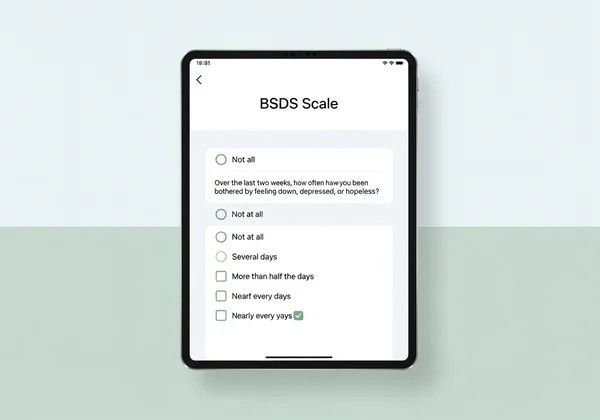
The Bipolar Spectrum Diagnostic Scale (BSDS) is a scientifically validated self-assessment tool used to screen for symptoms of bipolar spectrum disorder. Developed by Dr. Ronald Pies, it consists of a short descriptive story followed by a checklist of 19 items.
Its core purpose isn't diagnosis. It's a reliable first step. This tool helps you and your doctor spot mood and energy patterns typical of bipolar disorder. Think of it as a structured way to organize your experiences, making it easier to have productive chats with a professional. The BSDS helps bridge the gap between feeling that something is off and understanding what to do next.
Why Learn Manual BSDS Scoring?
Online tools give instant results, but learning the manual scoring process has unique advantages. It demystifies the assessment and shows you exactly how your final score comes together. This transparency builds trust and helps you grasp the significance of each of your responses.
Seeing the math firsthand gets you more invested in your answers. It encourages you to reflect more carefully on your experiences and prepares you for a more informed discussion with a doctor or therapist. Knowing how the score is generated empowers you to own your results and take confident, proactive steps toward seeking professional guidance.
How to Score BSDS: A Step-by-Step Manual Guide
Scoring the BSDS is a straightforward process based on simple addition. By following these steps carefully, you can calculate a raw score that provides a preliminary indication of bipolar spectrum symptoms.
Preparing Your Worksheet and Understanding Question Weight
The BSDS is structured in two parts. The first part is a descriptive paragraph that sets the stage, asking you to identify if the story of mood swings sounds like your own experience. The second part is a checklist of 19 specific symptoms or feelings.
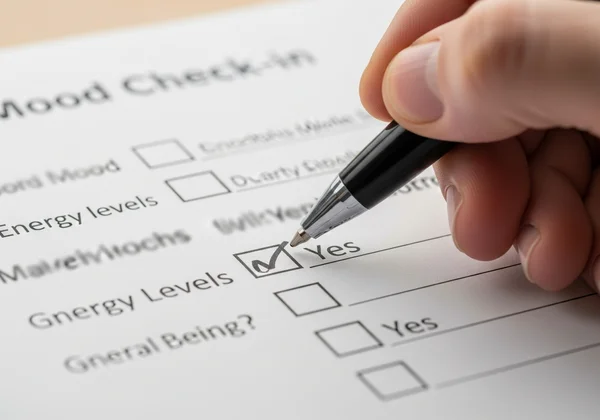
The manual score is based only on the 19-item checklist. Each question on the checklist has the same weight. Your task is to read each of the 19 statements and check "Yes" for every one that applies to your experience. There are no complex points or weighted values to worry about; it's a simple yes-or-no format.
Calculating Your Raw BSDS Score: Adding Up the Points
Once you have completed the 19-item checklist, the calculation is simple.
- Count the "Yes" answers: Go through your checklist and count every item you marked as "Yes."
- This is your raw score: The total number of "Yes" answers is your final BSDS score.
For example, if you checked "Yes" on 11 of the 19 items, your raw BSDS score is 11. It's as simple as that. There is no other calculation or conversion needed for the raw score.
Avoiding Common BSDS Scoring Mistakes
To ensure your self-assessment is as accurate as possible, be mindful of these common pitfalls:
- Focusing Only on Recent Moods: This screening tool assesses your experiences over your lifetime. Answer the checklist questions based on how you have felt throughout your life, not just in the past week or month.
- Misinterpreting the Initial Story: The introductory story is a prompt to help you connect with the overall concept of mood episodes. However, your score comes exclusively from the 19-item checklist that follows.
- Confusing a Score with a Diagnosis: This is the most critical point. A number is just data. It can't capture the full context of your life or health. Your score is an indicator, not a label.
For a completely error-free calculation and instant results, we recommend using our validated online tool. It eliminates any chance of manual error and helps you get an accurate score within minutes.
Interpreting Your BSDS Score Ranges
After calculating your raw score, the next step is understanding what it might suggest. Remember, these interpretations are based on clinical research and are intended to be guidelines, not definitive conclusions.
What Your Total BSDS Score Suggests
Clinical studies have established general score ranges to help interpret the results of the BSDS. While different studies may have slight variations, a common interpretation is as follows:
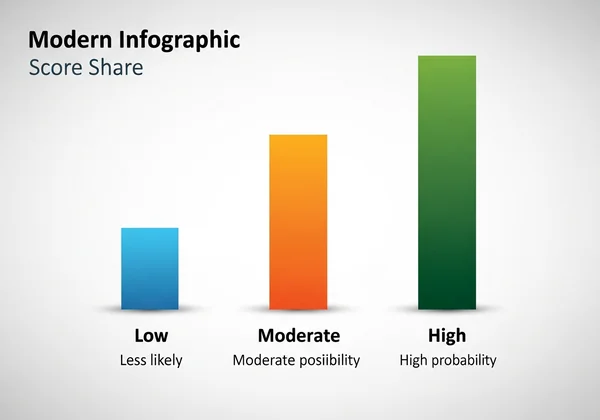
- Score of 0-6 (Low Range): A score in this range suggests that it's less likely your symptoms align with the bipolar spectrum. However, if you're still concerned about your mood, it's always wise to discuss it with a professional.
- Score of 7-13 (Moderate Range): This score indicates a moderate possibility of a bipolar spectrum condition. It serves as a strong signal that a follow-up conversation with a healthcare provider is a good idea.
- Score of 14-19 (High Range): A score in this range suggests a high probability that your symptoms are consistent with the bipolar spectrum. It's strongly recommended that you seek a comprehensive evaluation from a qualified mental health professional.
The Limitations of Self-Assessment: When to Seek Professional Help
Even the best self-assessment is just a starting point. It can't replace the nuanced understanding and clinical judgment of a trained professional. Doctors consider your full medical history, life circumstances, and other factors that a questionnaire can't capture.
Your BSDS score is a powerful piece of information to bring to your first appointment. It provides a concrete, structured summary of your experiences that can facilitate a productive and efficient diagnostic process. Regardless of your score, if you are struggling with your mental health, seeking professional help is the most important step you can take. Use your results to prepare for your consultation and start a meaningful dialogue.
Moving Forward: From Self-Assessment to Professional Insights
Understanding how to manually score the BSDS is an empowering exercise that gives you a deeper insight into your mental health patterns. You've learned how to turn your experiences into a quantifiable score that can serve as a valuable guide.
However, the ultimate goal isn't just to get a number, but to gain clarity and find a path forward. The most important takeaway is that this score is a tool to facilitate a conversation with a healthcare professional who can provide a true diagnosis and support.
Ready to take the first step towards clarity without the guesswork? Our free, confidential online tool automates this entire process for you. Start Your Free BSDS Assessment today, receive your results in minutes, and get the insights you need to move forward with confidence.
Frequently Asked Questions About BSDS Assessment
What is the Bipolar Spectrum Diagnostic Scale (BSDS)?
The BSDS is a respected and scientifically validated screening questionnaire designed to help individuals identify symptoms consistent with bipolar spectrum disorder. It's a self-assessment tool, not a diagnostic test, and is intended to be a first step toward seeking professional evaluation.
How accurate is the BSDS test for self-screening?
Clinical studies confirm the BSDS is reliable for screening. It flags people who need a deeper check for bipolar disorder. However, its accuracy depends on honest self-reporting and should always be followed up with a professional consultation.
Is the BSDS a definitive diagnosis for bipolar disorder?
No, absolutely not. The BSDS is a screening tool only. A definitive diagnosis for bipolar disorder can only be made by a qualified healthcare professional, such as a psychiatrist or psychologist, after a comprehensive evaluation of your symptoms, medical history, and life experiences.
What are the key signs of bipolar disorder that BSDS assesses?
This questionnaire assesses a lifetime history of symptoms related to mood episodes. It specifically looks for patterns that include periods of elevated mood, energy, and activity (known as mania or hypomania) in addition to periods of depression. The 19-item checklist covers a range of feelings and behaviors associated with these mood states. You can use our tool to explore your symptoms in a structured and confidential way.