Bipolar Disorder Unspecified ICD 10 F31.9 Meaning, Symptoms, and Code Context
If you searched for bipolar disorder unspecified ICD 10, you are probably trying to understand the meaning of F31.9. In ICD-10-CM, F31.9 is the code label for bipolar disorder, unspecified. It appears when the record points to bipolar disorder but does not give enough detail about the current episode, severity, remission status, or subtype to use a more specific F31 code. That small word, unspecified, matters: it is not a separate kind of bipolar disorder or a self-label from a search result. For people trying to organize mood-pattern questions before a professional visit, a gentle bipolar spectrum self-reflection tool can help turn scattered observations into clearer notes.
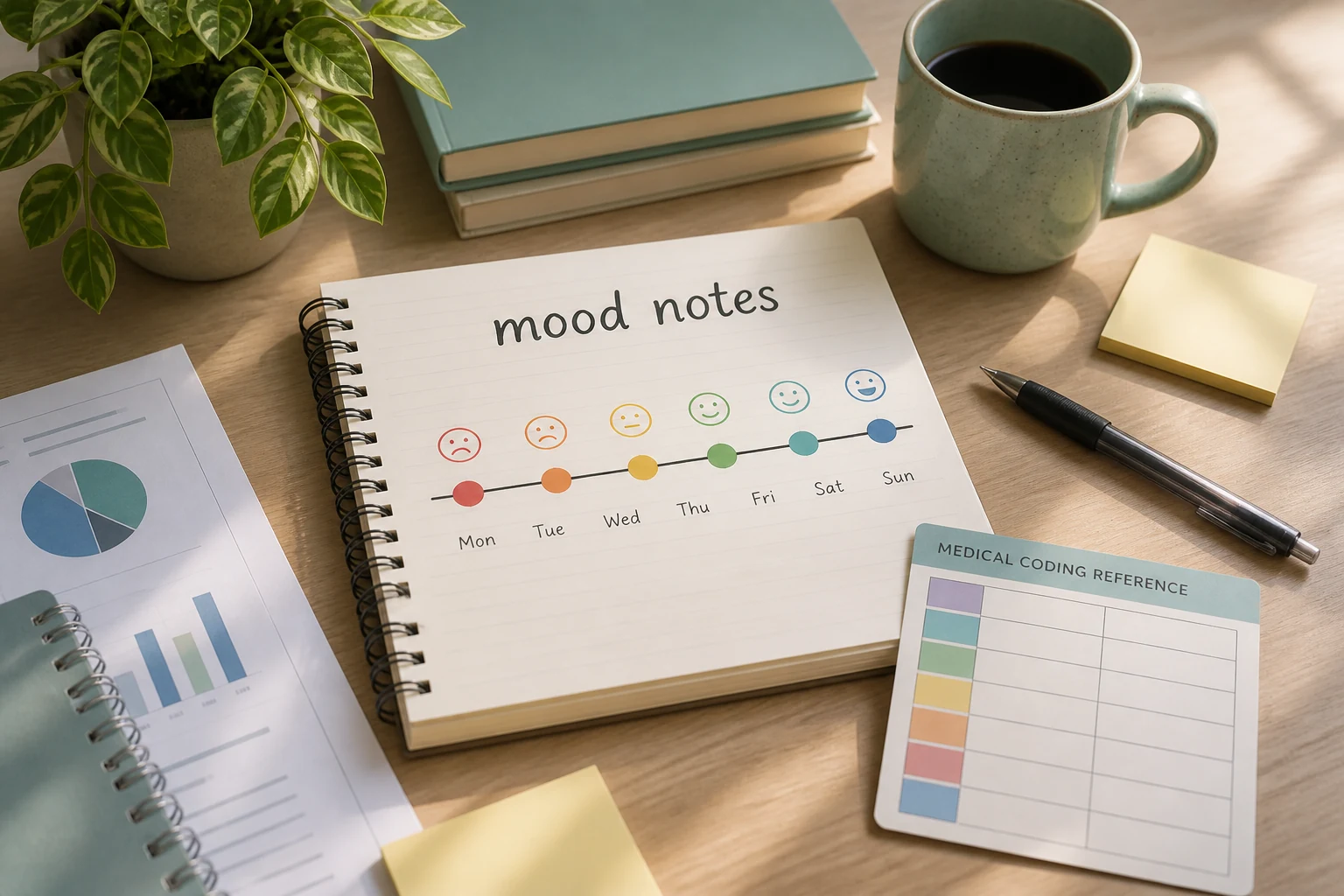
What F31.9 Means in ICD-10-CM
F31.9 sits inside the F31 family for bipolar disorder. The F31 group includes codes for current hypomanic, manic, depressed, mixed, remission, other bipolar disorder, and unspecified presentations. The code F31.9 is the broadest endpoint in that family.
In everyday terms, F31.9 says: the chart uses a bipolar disorder category, but the available information does not identify the more detailed episode pattern. A more specific code might describe whether the current episode is hypomanic, manic, depressed, mixed, severe, associated with psychotic features, or in remission. F31.9 leaves those details unstated.
This is why F31 9 bipolar disorder, unspecified can appear in billing records, visit summaries, insurance documents, or search snippets without explaining the lived experience behind it. The code is a shortcut, not a full clinical story.
It also helps to know the wording difference between systems and search terms. People often type bipolar affective disorder ICD-10 because ICD language in some contexts uses the phrase affective disorder. U.S. ICD-10-CM pages commonly show bipolar disorder, unspecified for F31.9. Those phrases are closely related in search intent, but the exact active wording should always be checked against the coding system used for the date and country involved.
F31.9 Symptoms and What the Code Does Not Tell You
A common search phrase is F31.9 bipolar disorder unspecified symptoms, but the code itself does not list a unique symptom set. It points to the broader bipolar disorder category while leaving episode details open. Bipolar-related patterns can involve changes in mood, energy, sleep, activity, speech, impulsivity, irritability, depression, or mixed states, but F31.9 does not say which of those are present for a particular person.
Avoid reading a code as if it explains everything. A person might have a code on a document because a clinician is still gathering history, because the available record is incomplete, or because the note does not specify the current episode. Another person might have a more specific F31 code because the current episode and severity are clearly described.
For self-reflection, the useful question is not "does F31.9 match my symptoms?" A safer question is "what mood, energy, sleep, and behavior patterns should I write down before I speak with a qualified professional?" A private BSDS-based bipolar spectrum screener can be one way to organize those observations, as long as the result is treated as educational screening rather than a medical conclusion.
How F31.9 Compares With Other Bipolar ICD-10 Codes
The ICD-10 code for bipolar disorder is not one single code. The F31 category works more like a set of shelves. F31.9 is one shelf, but many records need a more specific shelf when details are available.
| Search term | Better way to understand it |
|---|---|
| f31 9 icd 10 | F31.9 means bipolar disorder, unspecified. |
| bipolar 1 disorder icd-10 | Bipolar I patterns are often represented by more specific F31 codes based on the current or most recent episode. |
| bipolar 2 icd 10 | Bipolar II disorder is commonly represented by F31.81 in ICD-10-CM. |
| bipolar depression icd 10 | Depressive episodes in bipolar disorder may use F31.3, F31.4, or F31.5 depending on severity and psychotic features. |
| chronic bipolar disorder icd-10 | Chronic course alone is not usually enough; coding still depends on the documented episode, severity, and remission status. |
The phrase bipolar 1 disorder ICD-10 can be confusing because bipolar I is not always captured by one plain code. The record may need to show a current hypomanic, manic, depressed, mixed, or remission state. Similarly, bipolar depression is not the same as unipolar major depression in coding context. If a person has a bipolar history and is currently depressed, the F31 family may be relevant rather than a plain F32 or F33 depression code.
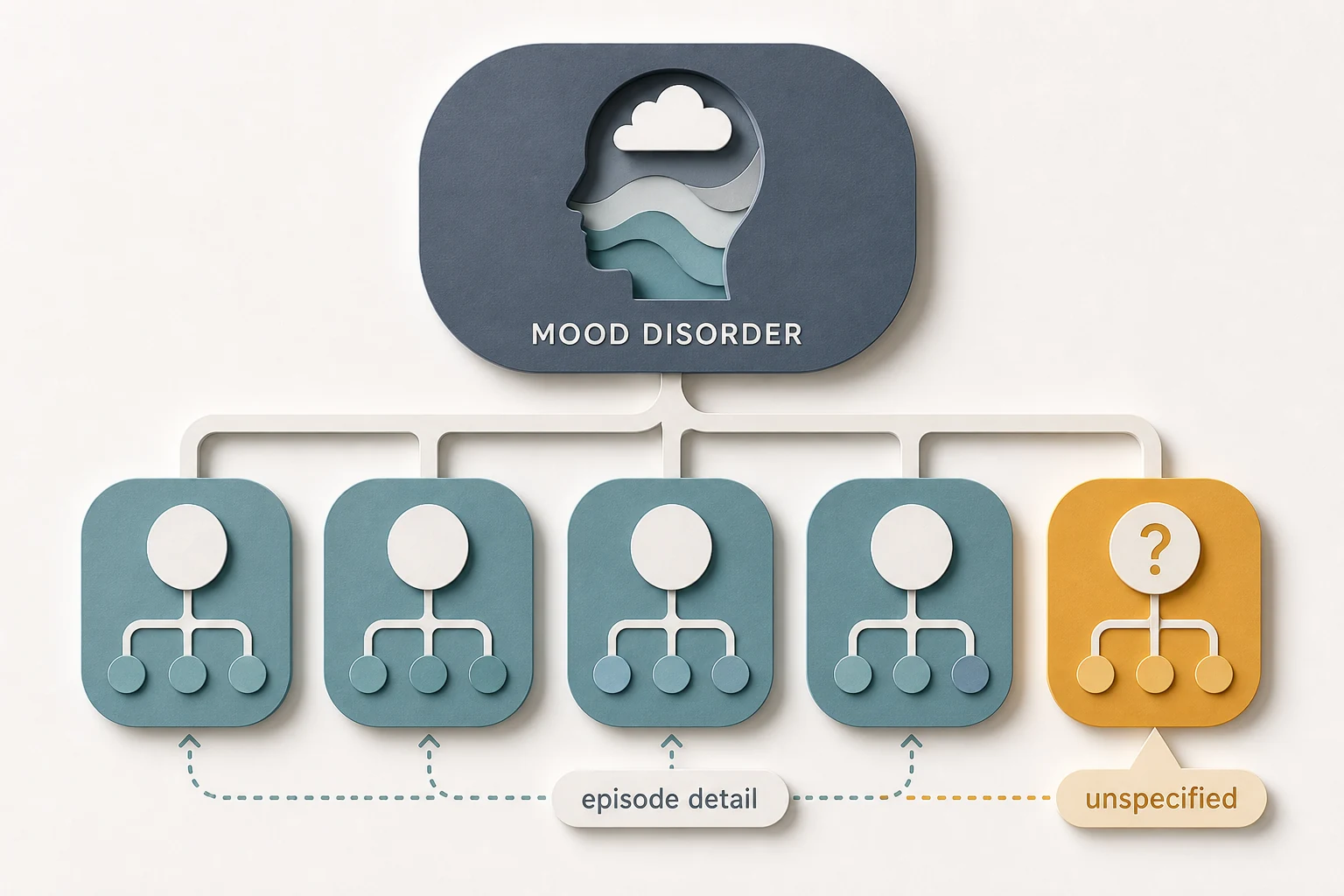
What About Depression and Anxiety in the Same Search?
Many people search for the ICD-10 code for bipolar disorder with depression and anxiety. That phrase mixes several ideas. Depression can be part of bipolar disorder, but ICD-10-CM coding usually depends on whether the depressive episode is mild, moderate, severe, with psychotic features, or described in another specific way. Anxiety may be documented as a separate condition or as a feature that shapes care, depending on the clinical record and coding rules.
So, F31.9 is not a special code for "bipolar plus depression and anxiety." It is the unspecified bipolar disorder code. If depression or anxiety is central to the presentation, a professional record may need more detail than F31.9 provides.
The practical takeaway: write down patterns, not codes. Note whether low mood, elevated mood, irritability, reduced need for sleep, racing thoughts, risky behavior, anxiety, or functional changes have happened in episodes. Include timing, duration, triggers, medication changes, substance use, sleep shifts, and family history if relevant. Those notes can support a better conversation without trying to turn a search query into a decision.
ICD-10, DSM-5, and ICD-11 Are Not Interchangeable
ICD-10-CM, DSM-5, and ICD-11 are related, but they are not the same tool. ICD-10-CM is widely used in U.S. health records and billing. DSM-5 is a clinical reference used by many mental health professionals for criteria and terminology. ICD-11 is the newer WHO classification that many countries are adopting on their own timelines.
The DSM-5 idea behind unspecified bipolar and related disorder is generally used when bipolar-related symptoms cause meaningful concern or impairment but the available information does not support a more specific bipolar category, or when the clinician does not specify the reason in that moment. ICD-10-CM F31.9 is a code label, not the full DSM-5 criteria.
Bipolar disorder ICD-11 searches add another layer. ICD-11 uses a different coding structure for bipolar and related disorders, including separate type I and type II categories and an unspecified category. That means an ICD-11 code should not be guessed from an ICD-10-CM code by swapping labels. The correct system depends on the country, organization, record type, and date.
A Practical Checklist Before You Discuss a Code
If F31.9 appears on a document or in a search result, these questions can make the next conversation clearer:
- What document showed the code, and what was the date of service?
- Was it ICD-10-CM, ICD-10, or another coding system?
- Did the note describe a current episode: hypomanic, manic, depressed, mixed, or in remission?
- Did the note mention severity, psychotic features, anxious distress, rapid cycling, or other specifiers?
- Was this an initial visit, a brief record, an insurance form, or a more complete clinical assessment?
- Were any other codes listed for anxiety, depression, substance use, sleep, or medical conditions?
- What symptoms, timing, and functional changes can you describe?
This checklist is not meant to make a person their own coder. It is meant to reduce confusion. Codes can feel cold and final, but in practice they often depend on documentation detail. If the record is unclear, asking for an explanation from the treating professional or billing office is reasonable.
How Screening Fits Into Code Questions
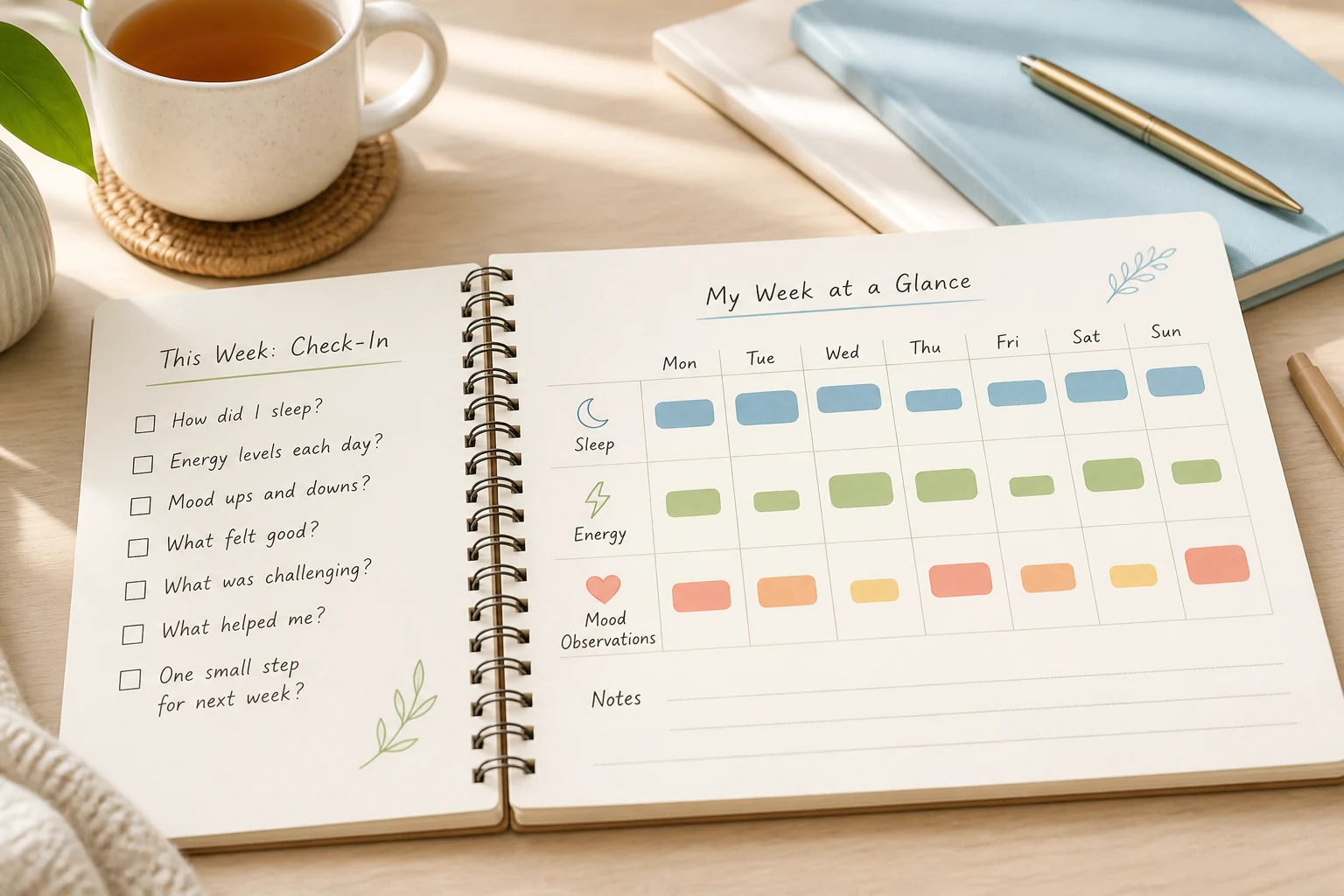
Online screening cannot replace a qualified evaluation, and it should not be used to select a billing code. Its value is different. A screening result can help someone notice patterns that are easy to forget during a short appointment: changes in sleep, bursts of energy, periods of unusually fast thinking, irritability, low mood, or shifts in activity.
That is where BSDS.me fits. The site centers on the Bipolar Spectrum Diagnostic Scale as an educational screening experience. It can help a person reflect on bipolar-spectrum patterns and prepare better notes, while keeping the boundary clear: screening is not the same as a clinical assessment, and an AI-powered explanation is not a medical record.
For someone reading about bipolar disorder unspecified ICD 10 after seeing F31.9, the best next step is often not to memorize every code. It is to gather context, ask what the code meant in that specific document, and discuss persistent mood concerns with a qualified professional.
Turning F31.9 Confusion Into a Better Next Conversation
F31.9 can be useful as a broad administrative label, but it is not very satisfying for a person who wants to understand their own mood patterns. The code does not explain whether symptoms are current, past, mild, severe, mixed, anxious, in remission, or related to another condition. It also does not tell you what treatment plan is appropriate.
Before your next appointment, consider making a one-page note with three parts: the code or phrase you saw, the mood and sleep patterns you have noticed, and the questions you want answered. You might ask whether F31.9 was used because details were missing, whether a more specific code applies, and what information would help clarify the record. For a low-pressure way to prepare that conversation, you can also review an educational bipolar spectrum questionnaire and bring the pattern notes rather than treating the score as a conclusion.

FAQ
What is bipolar disorder unspecified F31.9?
F31.9 is the ICD-10-CM code label for bipolar disorder, unspecified. It means the record uses the bipolar disorder category but does not give enough detail to identify a more specific current episode, severity, subtype, or remission code.
Is F31.9 the same as bipolar I disorder?
Not exactly. Bipolar I patterns are often represented with more specific F31 codes that describe the current or most recent episode. F31.9 is broader and less specific. It should not be read as a full explanation of type, episode, or severity.
What are F31.9 bipolar disorder unspecified symptoms?
F31.9 does not have its own unique symptom list. It points to the broader bipolar disorder category while leaving episode details unspecified. Symptoms and history need to be interpreted by a qualified professional in context.
What is the DSM-5 definition of unspecified bipolar disorder?
DSM-5 uses unspecified bipolar and related disorder when bipolar-related symptoms are clinically meaningful but the available information does not support a more specific category, or when the reason is not specified. ICD-10-CM F31.9 is a coding label, not the full DSM-5 criteria.
What are the ICD-10 criteria for bipolar disorder?
ICD-10 is a classification system, so code selection depends on the documented condition, episode type, severity, psychotic features, and course. It is better to think of F31 codes as documentation categories rather than a self-check checklist.
What are common treatment guideline themes for bipolar disorder?
Guidelines commonly emphasize professional assessment, individualized planning, mood-stabilizing medication when appropriate, psychotherapy or psychoeducation, sleep and routine support, monitoring for risk, and ongoing follow-up. Treatment choices should be made with a qualified healthcare professional.
How does bipolar disorder ICD-11 differ from ICD-10?
ICD-11 uses a newer structure for bipolar and related disorders, including separate categories for type I, type II, and unspecified bipolar or related disorders. Codes should be checked in the system used by the country or organization involved.